
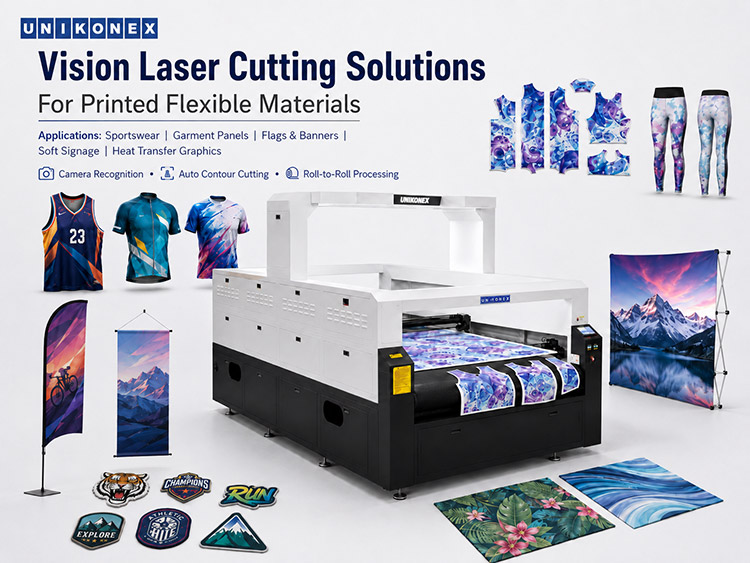
In recent years, one trend has become increasingly visible across the digital printing and heat transfer industry: more printing and transfer equipment manufacturers are adding vision laser cutting systems to their product portfolios.
A decade ago, the boundaries were easier to recognize. Printing was printing. Heat transfer was heat transfer. Cutting was cutting. Today, those product boundaries are becoming increasingly blurred.
At first glance, this looks like a straightforward product-line expansion. But there is a deeper change underneath it. As equipment markets mature, competition becomes denser, prices become more transparent and margins come under pressure, manufacturers naturally look upstream and downstream for additional revenue and a larger share of the customer relationship.
The competition is no longer only about selling one more machine. It is increasingly about who controls more of the customer’s production workflow.
From individual machines to an integrated workflow
For many sublimation businesses, the production chain is easy to describe: Print → Transfer → Cut.
Traditionally, each stage could involve a different equipment supplier. One company supplied the printer. Another supplied the calendar or heat press. A third supplied the cutting system.
Today, more manufacturers want to offer several stages under one roof. Commercially, the logic is clear. A broader portfolio can increase account value, reduce the risk of losing the customer to another supplier, and position one company closer to the center of the production process.
For the customer, there can be real advantages as well: fewer suppliers, simpler communication, easier purchasing and potentially clearer responsibility across the line.
But there is one important distinction that should not be lost in the move toward “one-stop solutions.”
Products can be added to the same catalogue quickly. Expertise cannot.
The workflow may be connected, but the technologies are not the same
Each category of industrial equipment has its own technical system, failure modes and experience curve.
Printing equipment manufacturers spend years dealing with printheads, inks, color management, media behavior, environmental conditions and printing stability. Heat transfer equipment requires deep understanding of temperature, pressure, speed, tension and material response.
Vision laser cutting has a different set of variables: camera recognition, print distortion, feeding accuracy, motion control, laser power, cutting parameters, exhaust design, material tension and the behavior of different fabrics in continuous production.
These machines may belong to the same workflow, but they are not the same technology. This is why specialization still matters in industrial equipment.
Commercial boundaries can be crossed quickly. Technical boundaries take time to cross.
The difficult part is not making a machine cut
From the outside, a vision laser cutter can look relatively simple: a camera sees the printed graphic, software creates or matches the cutting path, and the laser follows it.
Real production is more complicated.
A customer may cut standard polyester today and highly elastic sportswear fabric tomorrow. After heat transfer, the printed image may have stretched, shrunk or distorted. Continuous feeding can introduce drift. Different coatings and fabric structures can change the cutting response. Higher nominal speed can expose new limits in recognition, feeding, motion control or edge quality.
That creates a very different set of questions from the ones found on a specification sheet: Can the system still recognize a distorted image accurately? Can it maintain feeding stability over long production runs? Can the machine keep cutting quality consistent when material behavior changes? Is a problem coming from vision software, mechanics, material tension or the upstream production process?
These questions are rarely solved by hardware alone. They require diagnosis, accumulated cases and an understanding of how the full production environment behaves.
Experience is a form of technology
Industrial machinery is often compared through visible specifications: speed, working area, laser power, accuracy, number of heads, camera configuration and automation features.
Those specifications matter. But as markets mature, they are also the easiest layer for competitors to study and match. Mechanical structures can be copied. Components are available through increasingly common supply chains. Software functions can be reproduced. Even machine appearances can converge.
What is harder to reproduce is accumulated technical judgment.
It is the ability to recognize which materials are likely to distort, when feeding instability is actually caused by tension, when a recognition problem is mechanical rather than optical, when higher speed will reduce real output instead of improving it, and when the correct answer is to change the process rather than simply change a machine parameter.
This type of judgment is built through installations, sample testing, troubleshooting, failed trials, customer feedback and repeated problem solving. It is not created simply because a new product is added to a sales brochure.
One-stop solution or one-stop selling?
There is nothing wrong with a printing equipment manufacturer selling cutting systems, just as there is nothing wrong with a cutting equipment company expanding into other parts of the workflow. Industrial markets evolve, companies broaden their portfolios and customers increasingly look for integrated solutions.
The more useful question is not whether a company should expand. It is how much technical depth exists behind each category it offers.
A one-stop solution creates value only when every critical part of the solution is genuinely understood. Otherwise, one-stop solution can quietly become one-stop selling: the customer buys several machines from one supplier, but when a difficult production problem appears, specialist knowledge is still needed.
Integration and specialization are therefore not opposites. The strongest solution may come from combining both: a connected workflow with real technical depth at each stage.
The next competition will happen on two levels
The first level is workflow integration. Who can cover more of the customer’s production process? Who can reduce coordination cost? Who can connect Print, Transfer and Cut more effectively?
The second level is technical depth. Who understands the difficult cases? Who can handle the exceptions rather than only the standard demo? Who can keep production stable when materials, orders and operating conditions change?
These are different capabilities, and both will matter.
A broad product portfolio can create access to the customer. Deep specialization determines how much of the customer’s real production complexity a supplier can actually solve.
Why specialization still matters in vision laser cutting
At Unikonex, our focus has remained on vision laser cutting for flexible materials and the production problems around it. That focus matters because real applications do not stay inside a clean specification table. Sublimation sportswear, printed fabrics, soft signage and other flexible materials all introduce different combinations of distortion, feeding, recognition and cutting requirements.
The value of specialization is not simply that a company has been in one category for longer. The value is what that accumulated experience allows the supplier to diagnose, prevent and solve in real production.
As product boundaries continue to blur, this distinction may become even more important.
Product portfolios can expand quickly. Deep technical judgment takes time.
Final thought
When printing equipment companies begin selling cutting systems, it should not automatically be interpreted as proof that one market is “better” than another, nor as a sign that specialist manufacturers are becoming irrelevant.
It is better understood as part of a broader restructuring of the value chain. Companies are competing for a larger share of the workflow, a larger share of customer attention and a larger share of the available margin.
But every stage of production still has its own complexity. The companies that remain valuable will not necessarily be those with the longest product list. They may be the ones that can combine broader workflow understanding with genuine technical depth where it matters most.
Because machines can be copied. Product lines can be expanded. But expertise built from years of real production problems is much harder to replicate.
About Unikonex
Unikonex develops CO₂ vision laser cutting systems for flexible materials, including applications in sublimation sportswear, printed textiles, soft signage and related digital-printing workflows.